
War In Venezuela
The "pro-peace" US leader wants regime change, it seems like he got it.

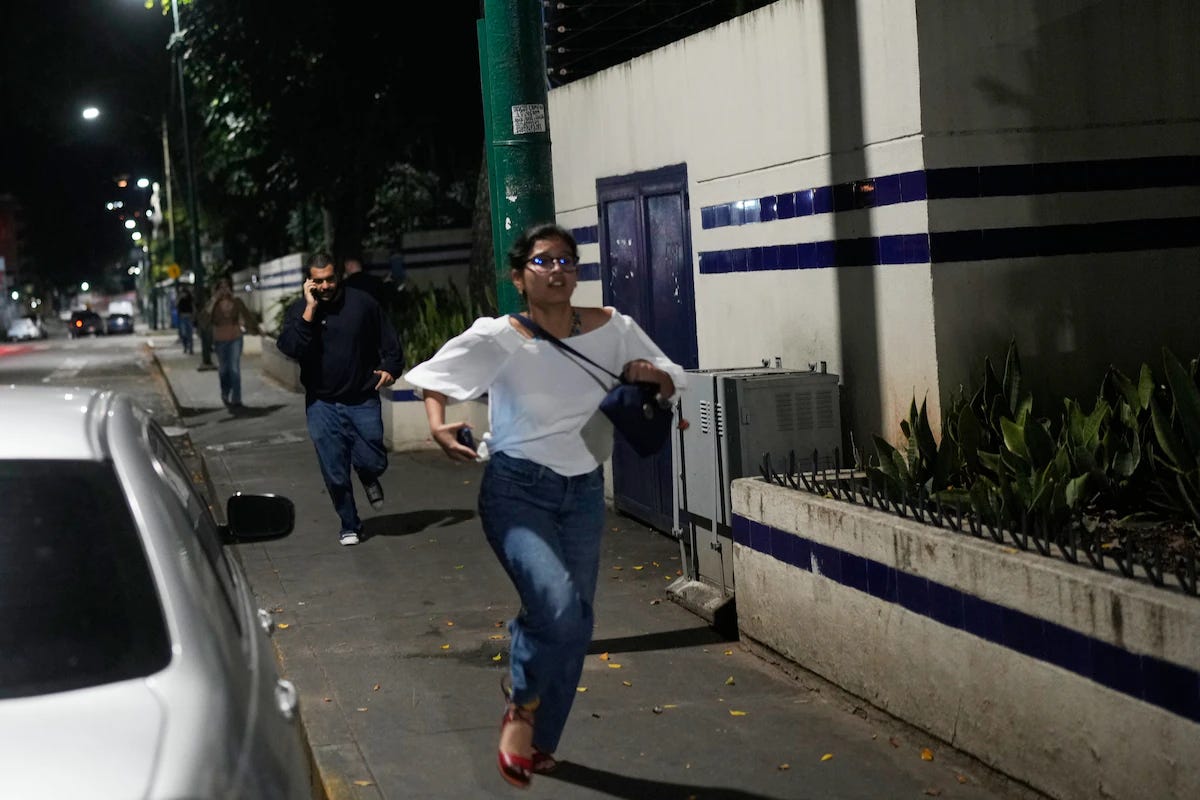
A large military buildup since last August, a military strike campaign against alleged drug boats off the coast of Venezuela that is legally dubious at best, an aggressive campaign against Venezuelan oil tankers, and more aggressive posturing by the Trump administration by declaring Venezuela a “narco-terrorist” state. All of it has led to this.
In Venezuela, residents of the capital, Caracas, reported loud explosions and smoke on Saturday morning. Aircraft were spotted by local Venezuelans, while some areas of the city are without electricity.
CBS News confirmed that Trump had directed military forces to strike targets in Caracas, as Venezuelan leader Nicolas Maduro’s government accused the US leader of trying to “seize oil and minerals” and declared an emergency. Saying it “rejects, repudiates, and denounces” the US’s “military aggression,” the Venezuelan government added the strikes targeted civilian and military areas of Caracas and the states of Miranda, Aragua, and La Guaira. According to Bloomberg, Maduro signed a decree that declares a “foreign disturbance,” which enables the start of “armed struggle.” A statement by Maduro also called on its supporters to take to the streets, saying, “The Bolivarian Government calls on all social and political forces in the country to activate mobilization plans and repudiate this imperialist attack.”
The FAA then announced it is banning US commercial flights in Venezuelan airspace, citing “ongoing military activity” ahead of explosions in Caracas. Rosali Hernandez, a local journalist, told Sky News that official communication lines were “silenced,” while the public is not informed about the cause of the explosions. Hours later, Trump confirms Maduro was captured and flown out of the country along with his wife, telling the NYT in a brief phone interview after the operation, “A lot of good planning and lot of great, great troops and great people. It was a brilliant operation, actually.” According to Sky News, Venezuelan opposition members said Maduro’s capture was a “negotiated exit.”
The United States of America has successfully carried out a large scale strike against Venezuela and its leader, President Nicolas Maduro, who has been, along with his wife, captured and flown out of the Country.
“This operation was done in conjunction with U.S. Law Enforcement. Details to follow. There will be a News Conference today at 11 A.M., at Mar-a-Lago. Thank you for your attention to this matter! President DONALD J. TRUMP.
Colombian President Gustavo Petro wrote on social media, “Alert to the whole world, they have attacked Venezuela. They are bombing with missiles. The OAS and the UN must meet immediately.” Petro then released an alleged list of bombed targets, including the Cuartel de la Montaña barracks in Caracas, a military base home to the mausoleum of Hugo Chavez, Maduro’s mentor and former Venezuelan leader. Cuban President Miguel Díaz-Canel denounced the attack, calling it “state terrorism,” while Iran’s regime reiterated “Venezuela’s inherent right to defend its national sovereignty and territorial integrity.” In the Caribbean region, the Secretary General of the Caribbean Community, Carla Barnett, started arranging an emergency leaders summit of the 15-nation bloc. Russia’s foreign ministry condemned the US’s “act of armed aggression against Venezuela,” while Argentina’s Javier Milei celebrated the news by tweeting, “Liberty advances.”
Venezuela’s defense minister, Vladimir Padrino, said the country will resist the presence of foreign troops, as he called the attack “deplorable” in a video statement. We also learned hours before the attack that Maduro met with a high-level Chinese delegation, telling Special Representative of the Chinese Government on Latin American Affairs Qiu Xiaoqi and fellow diplomats that he is a tiger. There is no information at the time of writing on whether the Chinese diplomats left Caracas before the strikes.
In the US, Democratic Senator Ruben Gallego of Arizona called the conflict the "Second unjustified war in my life time," while Republican Senator Mike Lee expressed skepticism when he wrote, "I look forward to learning what, if anything, might constitutionally justify this action in the absence of a declaration of war or authorization for the use of military force."
None of this should be surprising, given how the chips fell into place since August 2025. Just in the days leading up to Saturday, Trump said in a radio interview that US forces have “knocked out” a “big” facility in Venezuela, which American officials then referred to as an alleged drug facility, and provided not much more information. Multiple outlets, including CNN, then reported that the CIA carried out a drone strike at a port facility on the coast of Venezuela, marking the first known US attack inside the country. At the same time, the US killed two more people in a vessel located in the eastern Pacific as part of its boat strike campaign. Meanwhile, Maduro said he is open to dialogue with the US about drug trafficking, oil, and migration issues.
There are still a lot of unknowns surrounding the strikes within Venezuela, and a lot of speculation on what could come next. One thing is for sure: This is not just a simple conflict about oil, as some proclaim; all of this is about regime change and removing Nicolas Maduro from power. Maintaining his grip on power since 2013, after the death of Hugo Chavez, Maduro was never a popular leader. Venezuela’s economy collapsed under his watch after years of economic mismanagement and falling oil prices at the 2010s, which was only worsened by money printing, which led to hyperinflation that made the currency worthless. Adding on top of that, corruption and international sanctions have increased the pressure against Maduro. Severe shortages of food and medicine have plagued the nation for years, as more than 8 million people emigrated from Venezuela.
In response to political challenges, Maduro has repeatedly enacted brutal crackdowns on protests, concentrating power in the hands of loyalists and the military by forming parallel institutions to neuter the then-opposition-led Congress. On foreign policy, Maduro is in close alliance with Russia, China, and Cuba. At the same time, Maduro’s “Bolivarian revolution” movement has seen America as an imperialist power, while the US has charged Maduro and several of his top lieutenants with narco-terrorism and drug trafficking charges in 2020.
He is also accused of rigging the past two elections. Most recently, Maduro was declared the victor in the 2024 election, which was widely denounced by the Venezuelan opposition and international observers. The US recognized Edmundo González, the opposition leader, as the winner and imposed more sanctions in protest of the alleged rigged outcome.
Now, the uncertainty only gets more severe. The Venezuelan constitution states that power will now move towards Vice President Rodríguez, but many in the Venezuelan opposition argue the rightful president is the exiled Gonzalez. There could be a US-led democratic transition, which will almost certainly involve Nobel Peace Prize winner María Corina Machado, who has cozied up with the Trump administration in the past few months. But whether the transition would happen, and if it does, whether it would be successful and be accepted by members of the Venezuelan public, is yet to be seen.
Donald Trump, Secretary of State Marco Rubio, and the Trump administration want regime change; they have gotten it, and now they have to deal with the mess afterwards. Not only does the administration need to explain what authority it has to suddenly kidnap a world leader (A power that Congress has to authorize before conducting such operations), but the US now has to deal with the moral and political responsibility for what comes next. As history has shown, any US-led regime change hardly goes well in the long term (See Iraq and Afghanistan).


A mix of emotions has engulfed many Venezuelans: Shock at the barely believable news that Maduro has been removed from power after years of failed attempts to unseat the government, fear at what comes next and whether the attacks on Saturday midnight are a blip or a prelude, and a little bit of excitement at the removal of the Maduro regime, leading into a brief sense hope for a future democratic government.
It has certainly been a lot to process for Venezuelans, Americans, and the world. But at this moment, Venezuela’s political world has turned upside down. More uncertainly looms at the distance.
What Maduro did to Venezuela is what Trump is doing to the United States. It takes an evil dictator to know an evil dictator. As for this Congress it takes them 2 days to figure out what coffee to drink. They know what’s going on….no balls or spines to react. The horrendous war in Vietnam has taught them nothing☠️☠️☠️
Congress has been hijacked and is unwilling to do their job!!!☮️🦘